
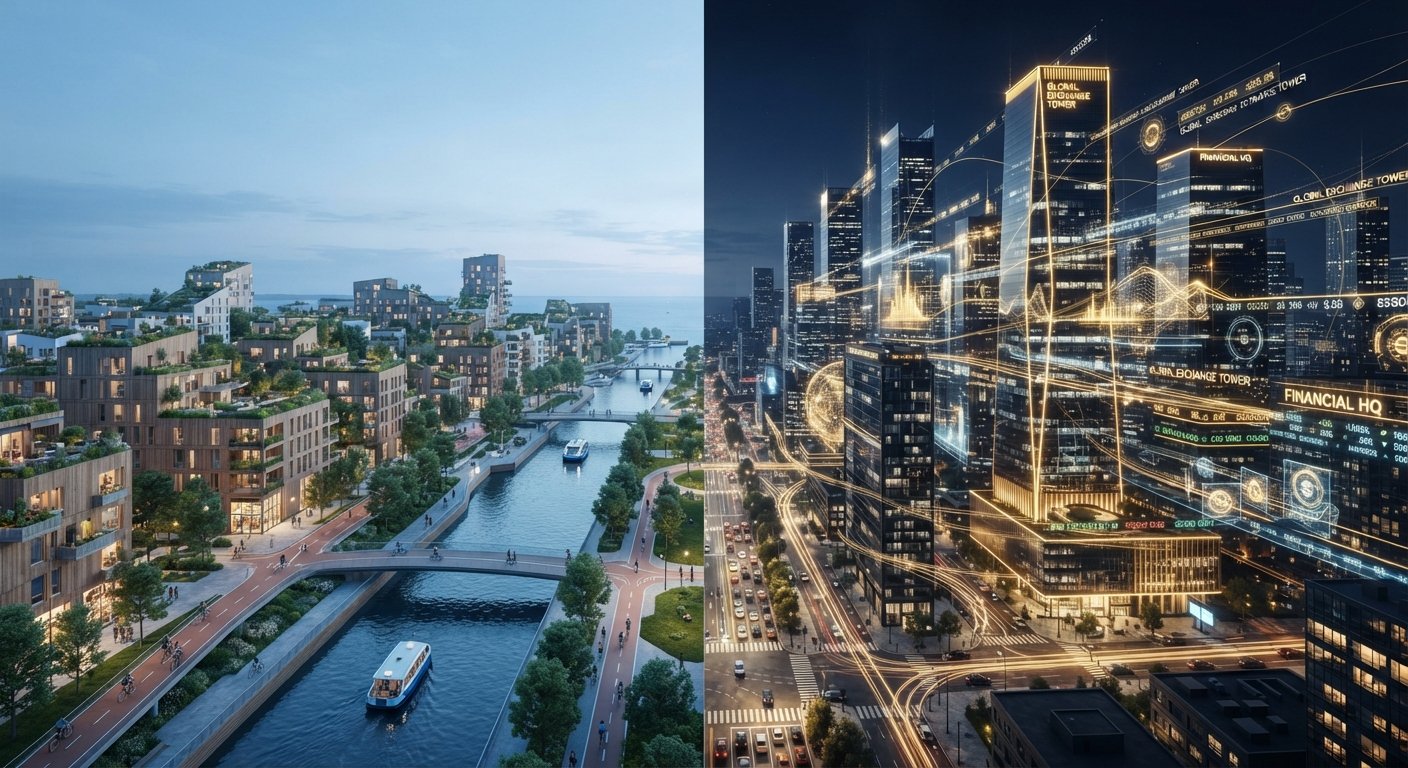
When analyzing modern global urbanization, a fascinating economic and social paradox emerges: the cities that consistently top quality-of-life rankings are rarely the same metropolises driving global financial markets. Evaluating the structural divide between most liveable cities reveals how distinct policy priorities, capital allocations, and infrastructure investments shape human habitat. While financial capitals maximize corporate productivity and capital liquidity, liveable urban centers prioritize ecological sustainability, public safety, and citizen well-being.
Key Takeaways
- Diverging Metrics: Livability indexes focus on healthcare, stability, and green space, whereas economic powerhouses measure gross domestic product, market capitalization, and corporate headquarters concentration.
- Scale Versus Balance: Economic giants like New York, Tokyo, or London generate immense wealth but often struggle with housing affordability and congestion, unlike top-tier liveable cities like Copenhagen or Vienna.
- Infrastructure Priorities: Liveable cities heavily invest in universal public transit and green corridors, while powerhouses focus on high-speed telecommunications and international logistics networks.
- The Talent Attraction Trade-off: High-income professionals often migrate to economic powerhouses for career acceleration, later seeking the balanced lifestyle found in top liveable regions.
The Core Philosophy: Quality of Life vs. Financial Output
To understand the friction in the debate of most liveable cities vs economic powerhouses, urban economists examine the core criteria used by global assessment frameworks. Annual evaluations—such as the Economist Intelligence Unit (EIU) Liveability Index—measure cities across stability, healthcare, culture, environment, education, and infrastructure.
Conversely, economic performance rankings focus intensely on foreign direct investment (FDI), output per capita, and equity market depth. Consequently, mid-sized European or Australasian cities frequently dominate livability charts, while mega-cities with massive GDP contributions often rank lower due to high stress levels, pollution, and traffic congestion.
Comparative Breakdown: Liveable Cities vs. Economic Powerhouses
A review of structural urban indicators highlights how these two distinct models allocate resources:
| Urban Category | Primary Global Examples | Core Strategic Focus | Key Trade-off / Weakness |
| Most Liveable Cities | Copenhagen, Vienna, Zurich | Public welfare, green infrastructure, social stability | Higher cost of living and slower corporate market scaling |
| Economic Powerhouses | New York, Tokyo, London | Capital liquidity, innovation clusters, job creation | Higher income inequality, congestion, and housing strain |

How Infrastructure and Governance Shape Urban Success
1. The Economics of Public Space and Livability
In cities consistently rated as highly liveable, urban planning places human scale at the forefront. Investments in clean energy, extensive cycling lanes, and universal public services create an environment that lowers chronic stress and boosts public health. This focus requires substantial public spending, funded through progressive taxation and stable governance models.
2. Capital Agglomeration in Economic Giants
On the other hand, economic powerhouses thrive on agglomeration economies—bringing together millions of workers, specialized service providers, and venture capitalists into a single dense network. This hyper-concentration generates exceptional wealth and career mobility, but it frequently strains municipal infrastructure and inflates real estate markets.

Bridging the Gap: Can a City Be Both?
As urban centers face modern challenges like climate change and demographic shifts, city planners increasingly attempt to merge the best attributes of both categories. Integrating smart-city technologies, expanding green transit networks within financial hubs, and introducing affordable housing mandates are vital steps toward harmonizing productivity with well-being.
Conclusion
The ongoing comparison of most liveable cities vs economic powerhouses demonstrates that modern urban success is multifaceted. While economic giants fuel global trade and technological innovation, liveable cities prove that human-centric design, stability, and environmental health are equally essential for long-term societal prosperity.

Frequently Asked Questions (FAQs)
What is the difference between most liveable cities and economic powerhouses?
Liveable cities are evaluated based on healthcare, stability, environment, and infrastructure for everyday life, whereas economic powerhouses are measured by GDP output, financial liquidity, and job creation.
Why do top economic powerhouses rarely rank as the most liveable?
Mega-cities often face severe traffic congestion, higher pollution levels, housing affordability crises, and safety challenges that lower their overall livability scores compared to smaller, well-managed European or Australasian cities.
Which cities currently lead global livability rankings?
Cities like Copenhagen (Denmark), Vienna (Austria), Melbourne (Australia), and Zurich (Switzerland) consistently top global livability indexes due to exceptional infrastructure and public services.
Can an economic powerhouse also achieve high livability?
Yes, certain financial capitals with robust welfare systems and forward-thinking urban planning—such as Tokyo or Zurich—successfully balance strong economic output with high quality of life.
1 thought on “Most liveable cities vs economic powerhouses”