

The global financial architecture is undergoing its most radical transformation since the invention of electronic wire transfers. Central banks across the world are accelerating the development of Central Bank Digital Currencies (CBDCs)—sovereign digital tokens issued and backed directly by a nation’s monetary authority. As pilots transition into live operational deployments, CBDCs reshape modern banking by fundamentally altering how money is created, distributed, and settled across retail and wholesale financial channels.
Understanding how CBDCs reshape modern banking requires examining the structural disruption to traditional commercial bank deposits, real-time cross-border settlements, monetary policy transmission, and consumer financial privacy.
Key Takeaways
- Direct Sovereign Money: CBDCs represent a risk-free digital claim on the central bank, unlike commercial bank deposits or decentralized cryptocurrencies.
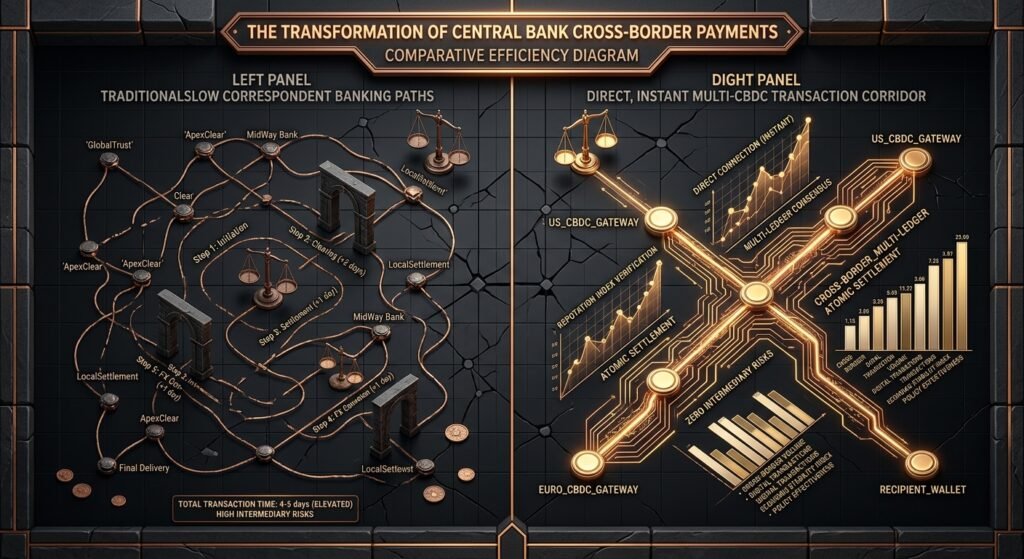
- Streamlined Cross-Border Payments: Multi-CBDC platforms eliminate intermediate correspondent banks, reducing international remittance costs and settlement times to seconds.
- Commercial Banking Disintermediation: Retail CBDC architectures pose liquidity risks for commercial banks if consumers shift deposits into central bank accounts during economic stress.
- Programmable Monetary Policy: Central banks can deploy smart contract features for targeted stimulus, automated tax collection, and instant interest adjustments.
Disruption to Commercial Banking and Financial Stability
A core reason CBDCs reshape modern banking so significantly is their potential to alter the traditional fractional-reserve banking model:
The Risk of Deposit Disintermediation
Commercial banks rely heavily on customer retail deposits to fund business and mortgage loans. If consumers perceive a central bank digital currency as safer during a crisis, mass migration of capital from commercial bank accounts to CBDC wallets could trigger rapid bank disintermediation and credit contraction.
Transition to Two-Tier Intermediated Frameworks
To mitigate disintermediation risks, most central banks are designing two-tier architectures. In this setup, the central bank manages the core ledger while commercial banks and regulated fintechs handle customer onboarding, KYC compliance, and front-end wallet interfaces.
Revolutionizing Cross-Border Trade and Payments
Cross-border payments historically suffer from high fees, currency conversion markups, and long clearance delays due to multiple correspondent banking hubs.
| Payment Mechanism | Settlement Speed | Intermediate Risk | Relative Transaction Costs |
| Traditional SWIFT Wire | 1 to 5 Business Days | High (Multiple Intermediary Banks) | High (Multiple FX & Cable Fees) |
| Card Payment Networks | Real-Time Authorization (Days to Settle) | Moderate (Acquirer/Issuer Processing) | High Interchange Fees |
| Interoperable Multi-CBDCs | Near-Instant (Atomic) | Minimal (Direct Central Bank Ledger) | Very Low |

Programmability, Privacy, and Policy Transmission
As CBDCs reshape modern banking, they introduce new tools for monetary policy and economic governance:
Direct Monetary Policy Transmission
Traditional monetary policy relies on interest rate changes trickling down through commercial bank lending rates. CBDCs allow central banks to pass interest rate adjustments directly to end-user balances, enhancing the speed and effectiveness of monetary intervention.
Privacy Safeguards vs. Regulatory Oversight
Designing CBDCs requires balancing consumer payment privacy with anti-money laundering (AML) mandates. Leading models implement tiered anonymity, where small daily transactions remain private, while larger transfers require standard institutional verification.

Strategic Considerations for Institutions and Businesses
To navigate the paradigm shift as CBDCs reshape modern banking, corporate executives and financial institutions should implement the following steps:
- Upgrade Core Core Payment Infrastructure: Ensure legacy treasury systems and ERP software support API connections to emerging digital sovereign wallets.
- Evaluate Liquidity and Yield Strategies: Monitor commercial bank deposit rate shifts as banks compete against non-yielding CBDCs for retail customer capital.
- Prepare for Automated Smart Contracts: Explore how programmable CBDC rails can automate supplier payouts, trade financing, and tax withholding.
Frequently Asked Questions (FAQs)
How do CBDCs reshape modern banking compared to cryptocurrencies?
CBDCs are centralized, legal tender issued and backed by sovereign central banks with fixed nominal value. Cryptocurrencies like Bitcoin are decentralized, unbacked assets characterized by high price volatility.
Will CBDCs replace commercial banks entirely?
No. Central banks are designing two-tier systems where commercial banks manage user accounts, customer service, and loan issuance, preserving the core functions of commercial banking.
Are CBDC transactions anonymous like cash?
Most retail CBDC proposals feature tiered privacy. Low-value everyday purchases may offer privacy, while higher-value transactions require identity verification to prevent illicit financial activities.