

Navigating global investment and macroeconomic trends requires looking beyond traditional industrialized nations. As established economies experience slowing growth baselines, adventurous investors and global strategists turn their attention to developing financial landscapes. When evaluating frontier markets explored across continents, analysts examine unique demographic advantages, under-penetrated consumer bases, and structural leapfrogging that set the stage for explosive long-term expansion.
Key Takeaways
- High Growth Potential: These developing economies offer significantly higher nominal yield opportunities compared to saturated saturated markets.
- Demographic Dividends: Rapidly expanding, youthful populations drive domestic consumption and scalable workforce expansion.
- Leapfrogging Technologies: Skipping legacy infrastructure phases allows rapid adoption of mobile financial systems and digital tools.
- Inherent Volatility: High growth comes with distinct regulatory, currency, and liquidity risks requiring calculated management.
Defining the Frontier Economy Landscape
To understand why frontier markets explored are drawing intense institutional scrutiny, we must first isolate what separates them from standard developing nations. While emerging economies possess established stock exchanges and moderate global liquidity, frontier economies represent smaller, less accessible, but rapidly evolving financial ecosystems.
Financial analysts typically use quantitative indicators—such as market capitalization, liquidity ratios, and institutional accessibility—to categorize these nations. Because their capital markets are still in formative stages, early investors can capture unprecedented value before mainstream institutional capital flows arrive.
Comparative Analysis of Major Developing Frontiers
A review of leading territories showcasing high-growth potential highlights diverse regional drivers of economic momentum:
| Country / Region | Estimated Growth Driver | Primary Sector Focus | Market Classification |
| Vietnam (Expanding Frontier) | Export manufacturing integration | Electronics, textiles, FDI | Southeast Asia |
| Kenya | Mobile technology & fintech | Digital banking, agriculture | East Africa |
| Bangladesh | Garment exports & labor scaling | Manufacturing, remittance | South Asia |
| Nigeria | Consumer demand & digital services | Energy, fintech, retail | West Africa |
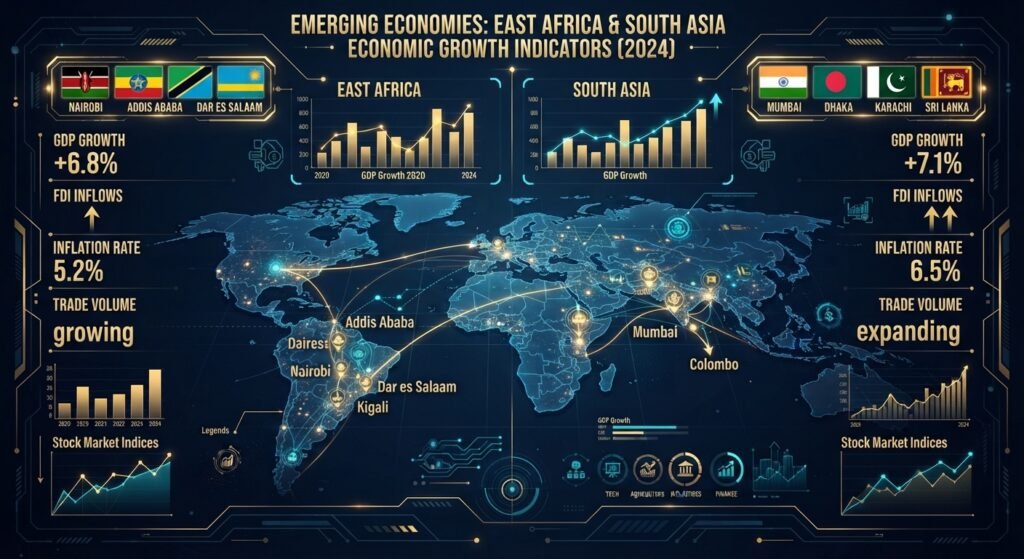
Core Growth Drivers in Developing Regions
1. The Power of Youthful Demographics
Unlike aging western populations, many nations featuring frontier markets explored boast median ages well under thirty. This massive workforce expansion translates directly into soaring domestic demand for housing, telecommunications, financial services, and consumer goods.
2. Technological Leapfrogging
Rather than building costly physical banking networks or landline infrastructures, these nations adopt mobile-first solutions immediately. Digital wallets and decentralized payment systems allow populations to integrate instantly into the formal economy, drastically reducing transaction friction.

Mitigating Risk While Pursuing High Growth
Capitalizing on frontier markets explored requires a clear-eyed assessment of structural vulnerabilities. Investors must navigate distinct challenges:
- Currency Devaluation: Local fiat currencies frequently experience high inflation rates and sudden exchange rate adjustments against major global reserves.
- Liquidity Constraints: Lower daily trading volumes mean large positions can be difficult to exit quickly without moving market prices.
- Regulatory Shifts: Evolving legal frameworks and political shifts can introduce sudden compliance hurdles for foreign capital.

Conclusion
The ongoing movement toward frontier markets explored marks a critical evolution in global macroeconomic strategy. While these regions carry elevated structural risks, their unmatched demographic advantages, technological adaptability, and high growth ceilings offer a compelling frontier for the next generation of capital allocation.
Frequently Asked Questions (FAQs)
What distinguishes frontier markets from emerging markets?
Frontier markets are smaller, less liquid, and less developed financially than emerging markets, offering higher potential growth coupled with greater structural and liquidity risks.
Why are investors focusing on developing financial frontiers?
Investors target these regions to capture early-stage growth, high demographic dividends, and diversification benefits away from saturated industrial economies.
What role does technology play in these economies?
Technology allows these nations to skip traditional industrial development phases, leveraging mobile infrastructure and digital finance to integrate rapidly into global commerce.
Are investments in these regions suitable for all portfolios?
Due to high currency volatility, lower liquidity, and regulatory uncertainty, allocations to these developing regions typically suit risk-tolerant portfolios with long-term investment horizons.
1 thought on “Frontier Markets Explored: Growth Economies”