

Evaluating individual earnings from a macroeconomic perspective requires looking past local cost-of-living standards and domestic tax brackets. Utilizing a global income rank calculator allows professionals and analysts to measure personal compensation against the worldwide population of over 8 billion people. Because nominal foreign exchange rates often distort true purchasing power, understanding global income distribution relies heavily on Purchasing Power Parity (PPP) adjustments.
Whether evaluating individual career progress or analyzing global economic inequality, measuring where a specific salary ranks on the world stage provides critical context regarding global wealth stratification.
Key Takeaways
- The Power of PPP: A global income rank calculator uses Purchasing Power Parity to account for local price level differences, ensuring fair salary comparisons between different nations.
- Global Median Realities: The global median income sits significantly lower than median wages in developed nations, meaning even modest middle-class salaries in Western countries often place earners in high global percentiles.
- Inequality Disparities: Wealth distribution is highly skewed; earning a relatively standard professional salary can easily rank an individual among the top global earners.
- Macroeconomic Context: Income rankings fluctuate based on household size, localized inflation rates, and evolving international exchange parameters published by institutions like the World Bank.
How Global Income Percentiles Are Calculated
Assessing individual standing within the global economic hierarchy involves converting local earnings into international dollars using standardized PPP conversion rates.
Because living costs vary dramatically between emerging markets and advanced economies, standard currency conversion alone fails to show true financial capability. PPP adjustments ensure that a dollar earned locally is measured by what it can actually buy locally.
Global Income Tiers and Salary Benchmarks
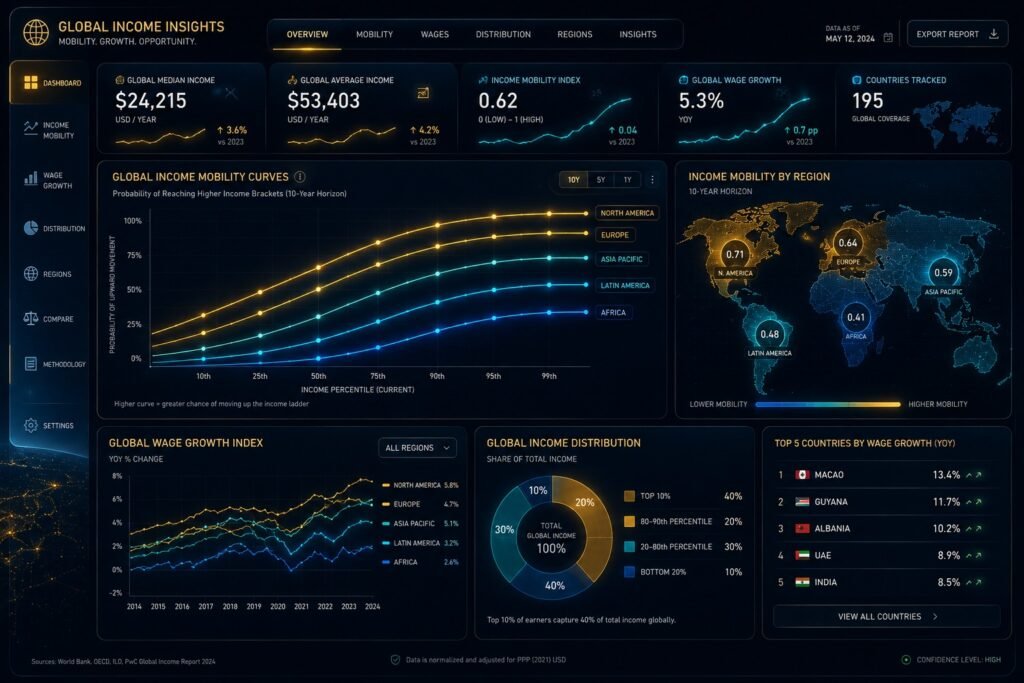
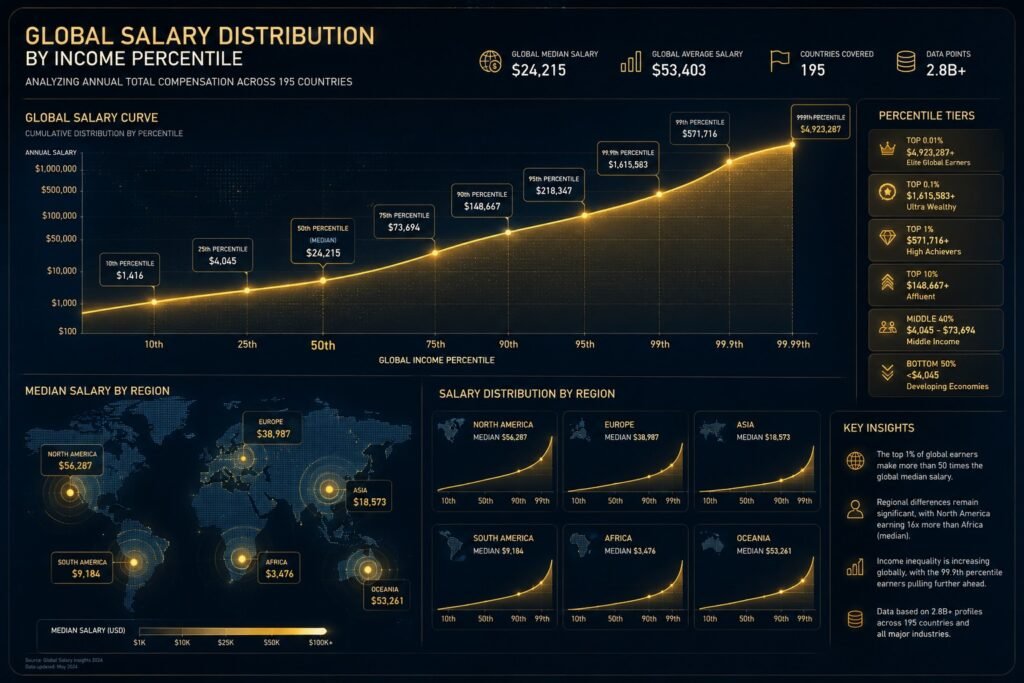
Comparative data derived from economic inequality platforms illustrates how various annual income thresholds translate to global percentiles:
| Global Income Tier | Approximate Annual PPP Income | Global Population Standing | Primary Economic Characteristics |
| Top 1% | $60,000+ | Top 80 Million People | Ultra-high global purchasing power; corporate executives, elite professionals |
| Top 10% | $25,000 – $60,000 | Top 800 Million People | Upper-middle class in developing nations, entry-level professional tiers in OECD countries |
| Global Median | Approx. $2,900 | 50th Percentile (The Exact Middle) | Standard subsistence or lower-middle-class income across global developing economies |
| Bottom 50% | Below $2,900 | Lower 4 Billion People | Developing rural economies, informal labor sectors, extreme poverty thresholds |
Key Factors Influencing Your Global Rank
When inputting data into a global income rank calculator, several variables alter the final percentile output:

1. Household Size and Equivalized Income
Individual salaries rarely paint a full picture of economic welfare. Household income calculators divide total family earnings by an equivalence scale to account for shared living expenses among dependents.
2. Regional Cost-of-Living Adjustments
A salary that affords upper-middle-class stability in a developing economy might cover only basic living expenses in high-cost metropolitan centers like New York or London. PPP frameworks correct these imbalances to reflect real utility.
Data Sources and Macroeconomic Transparency
Accurate tracking of global wealth requires robust datasets compiled by international organizations. Researchers and financial planners cross-reference findings from major repositories, such as the [External Link: World Bank Poverty and Inequality Platform], to monitor shifts in global purchasing power.
Conclusion
Using a global income rank calculator provides essential perspective on individual compensation relative to the entire world population. By adjusting for purchasing power parity and household size, these tools cut through nominal exchange rate noise to reveal true economic standing. Understanding these metrics helps economists, policymakers, and professionals navigate global wealth distribution trends with precision.
Frequently Asked Questions (FAQs)
What does a global income rank calculator measure?
A global income rank calculator evaluates an individual’s or household’s earnings against the worldwide population, determining their exact income percentile using Purchasing Power Parity (PPP) adjustments.
Why does the calculator use PPP instead of nominal exchange rates?
Purchasing Power Parity (PPP) adjusts for differences in local price levels and living costs between countries. This ensures that salaries are compared based on what money can actually buy locally rather than raw currency exchange values.
What income level puts you in the global top 10%?
Earning an annual PPP-adjusted income of approximately $25,000 to $60,000 typically places an individual among the top 10% of earners globally, given that the global median income is significantly lower.
How does household size affect my global income rank?
Calculators use equivalized income formulas to divide total household earnings by the number of household members, ensuring that single earners and large families are compared accurately based on resource sharing.
1 thought on “Global Income Rank Calculator: Compare Your Salary”