
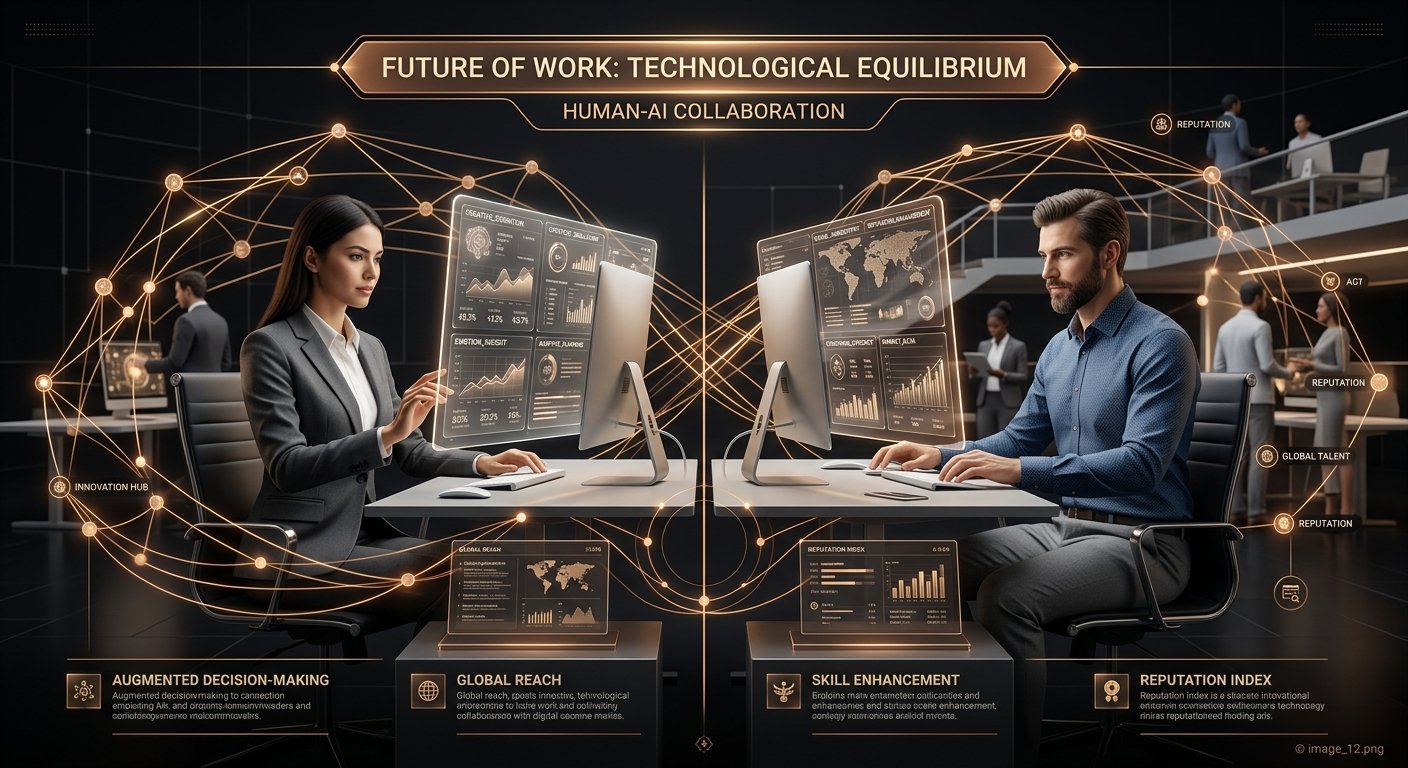
Navigating this complex economic transition requires more than reactive workforce cuts; it demands a clear strategic roadmap focused on balancing job displacement with unprecedented productivity. Rather than viewing artificial intelligence as a binary trade-off between labor reduction and profit margins, forward-thinking organizations are realizing that maximum long-term value stems from human-machine collaboration. Achieving lasting market stability will ultimately depend on how effectively institutions reskill their talent while harnessing technological scale.
Key Takeaways
- The Dual Economic Impact: While AI automation threatens routine cognitive and operational tasks, it simultaneously unlocks exponential output growth and operational speed.
- Task Automation vs. Role Elimination: Current technology primarily automates specific sub-tasks within jobs, creating opportunities to redesign positions around human high-value oversight.
- The “Augmentation First” Paradigm: Businesses that focus on augmenting existing employees achieve higher EBIT returns than those relying solely on labor headcount reduction.
- Proactive Skills Lifelong Learning: The global labor market is shifting emphasis toward human capabilities—such as strategic problem-solving, emotional intelligence, and agent orchestration.
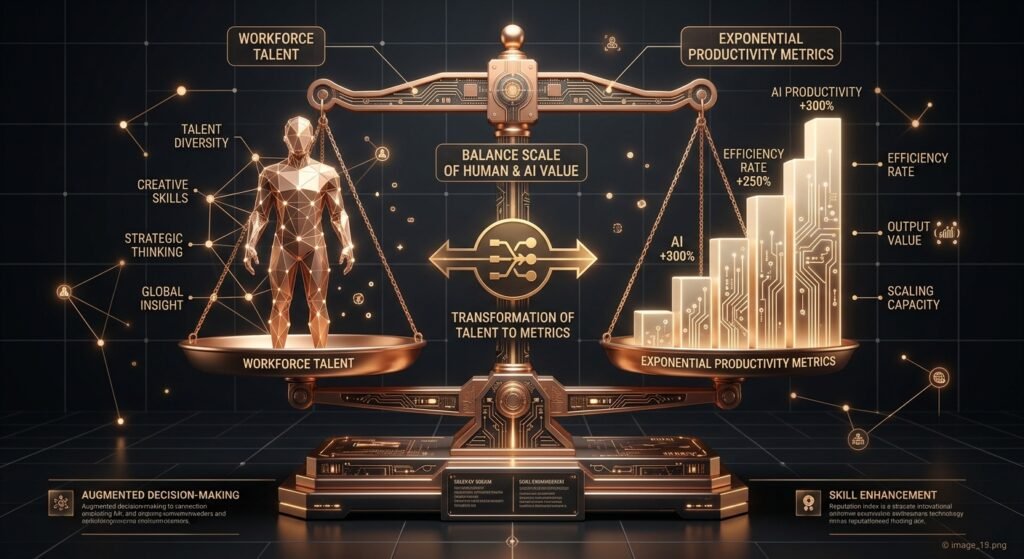
Key Drivers of the AI Productivity Explosion
Several technical and operational breakthroughs explain why modern efficiency gains are occurring at such an accelerated pace:
1. The Emergence of Autonomous Agent Networks
Unlike earlier software that required continuous manual prompting, modern agentic systems can independently execute multi-step workflows, write code, run compliance checks, and manage customer inquiries. This capability allows single operators to manage processes that previously required entire department teams.
2. Elimination of Cognitive Bottlenecks
Knowledge workers spend a significant portion of their workweek on information retrieval, summarization, and data formatting. By delegating these baseline tasks to specialized models, employees can direct their focus toward high-level strategy, client relationships, and creative problem-solving.
3. Democratization of Technical Execution
Low-code environments powered by intelligent assistants allow non-technical business leaders to build internal applications, analyze complex datasets, and automate custom operational pipelines without relying entirely on specialized IT teams.
Industry Sector Impact: Risk vs. Opportunity
Successfully balancing job displacement with unprecedented productivity requires an sector-by-sector perspective on where disruption and growth are most concentrated:
| Industry Sector | Primary Displacement Risk | Unprecedented Productivity Potential | Net Workforce Evolution |
| Software Development | Routine bug fixing and boilerplate coding. | 5x to 10x faster feature deployment and product iterations. | Shift toward systems architecture, security oversight, and AI orchestration. |
| Financial Services | Manual data entry, basic research, and initial underwriting. | Instant fraud detection, automated portfolio rebalancing, real-time reporting. | Growth in quantitative risk management and relationship-focused advising. |
| Customer Experience | Tier-1 support desk interactions and basic triage. | 24/7 personalized resolution, predictive support workflows. | Escalation management, high-empathy customer success coaching. |
| Legal & Compliance | Document discovery, basic contract drafting, regulatory cross-referencing. | Comprehensive contract analysis completed in seconds rather than days. | Increased focus on strategic negotiations and complex ethical governance. |

Strategic Frameworks for Corporate Leaders
To maintain organizational health while capturing technology gains, corporate leadership must implement intentional workforce transformation frameworks:
Redesign Workflows Around Human-in-the-Loop Architecture
Rather than replacing existing roles outright, structure systems so that automation handles the bulk execution while human experts provide validation, quality assurance, and nuance. This approach maintains operational safety while elevating output quality.

Actionable Steps for Professionals Navigating Labor Shifts
Individual professionals seeking long-term career security must proactively reposition their skill sets in response to evolving market demands:
- Master AI Tool Orchestration: Learn to effectively prompt, evaluate, and direct domain-specific tools within your profession rather than competing directly against automated tasks.
- Cultivate Irreplaceable Human Capabilities: Double down on negotiation, emotional intelligence, cross-functional leadership, and complex decision-making under uncertainty.
- Build Cross-Disciplinary Expertise: Combine domain expertise (e.g., healthcare, law, finance) with technical literacy to act as a bridge between engineering teams and executive leadership.
Conclusion
Achieving a sustainable economic future relies on balancing job displacement with unprecedented productivity through strategic, human-centered policy and enterprise planning. While rapid task automation creates genuine structural shifts across traditional roles, it also offers an opportunity to eliminate mundane labor and elevate human work toward strategic, creative, and interpersonal domains. By pairing technological deployment with continuous upskilling and organizational agility, businesses and workers alike can turn potential disruption into long-term prosperity.
Frequently Asked Questions (FAQs)
How can organizations succeed in balancing job displacement with unprecedented productivity?
Organizations achieve balance by focusing on worker augmentation rather than total workforce replacement. By training existing talent to oversee automated systems, enterprises capture efficiency gains while preserving crucial institutional knowledge.
Which skills offer the highest protection against job displacement?
Skills that require emotional intelligence, ethical judgment, strategic negotiations, complex system design, and specialized physical adaptability remain resilient against complete technical automation.
Does technological productivity growth always lead to net job losses?
Not necessarily. Historically, while major technological shifts displace specific routine roles, they also spark overall economic growth, lower the cost of goods and services, and create entirely new job categories and industries that did not exist previously.