
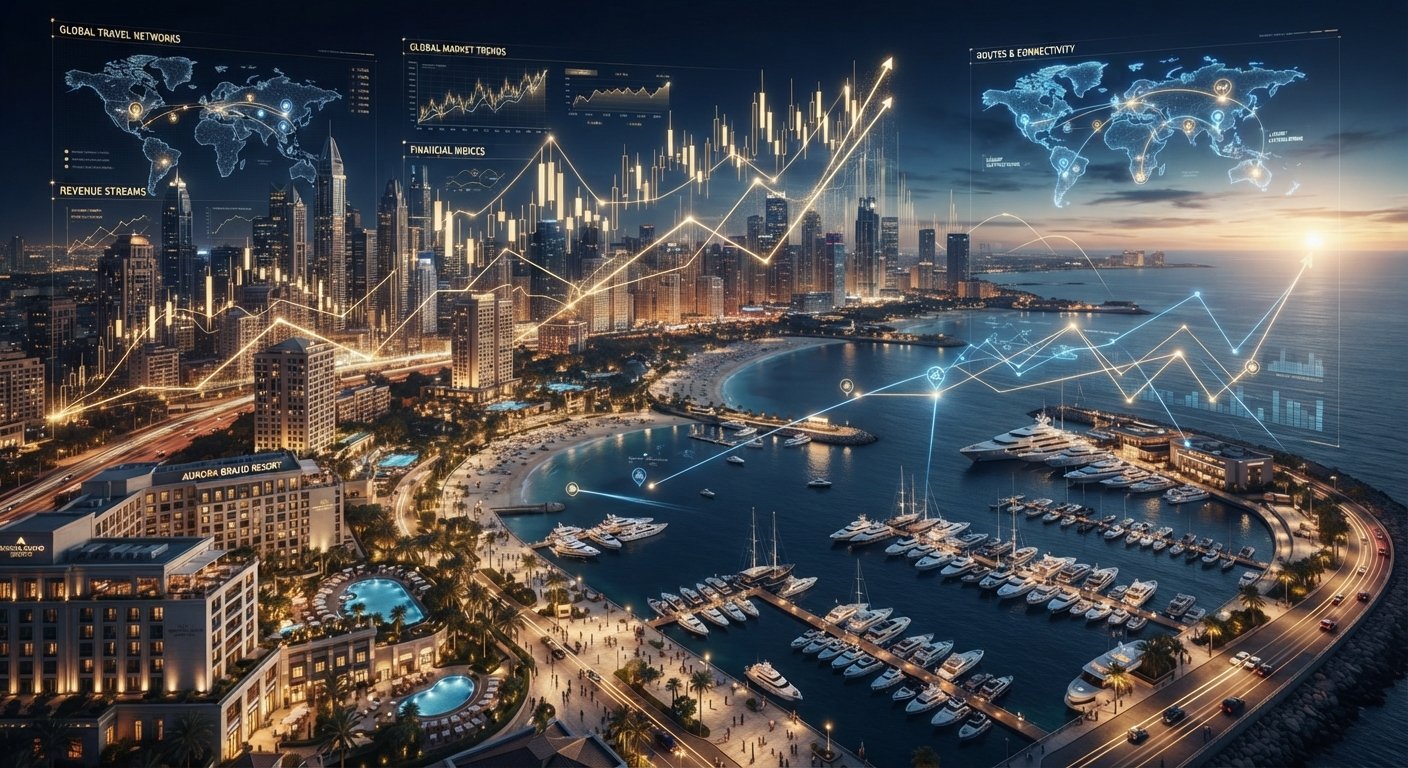
Evaluating macro-economic resilience and international trade dynamics requires looking beyond physical manufacturing and raw material exports to examine the service sector’s largest engine. Within the modern global tourism economy, international travel acts as a foundational pillar of sovereign wealth. With total economic contributions surpassing historic milestones, visitor expenditures, hospitality investments, and aviation networks dictate the financial stability of numerous nations across the globe.
Key Takeaways
- Record Economic Contribution: Travel and tourism generate multi-trillion-dollar impacts annually, consistently outpacing broader worldwide economic growth rates.
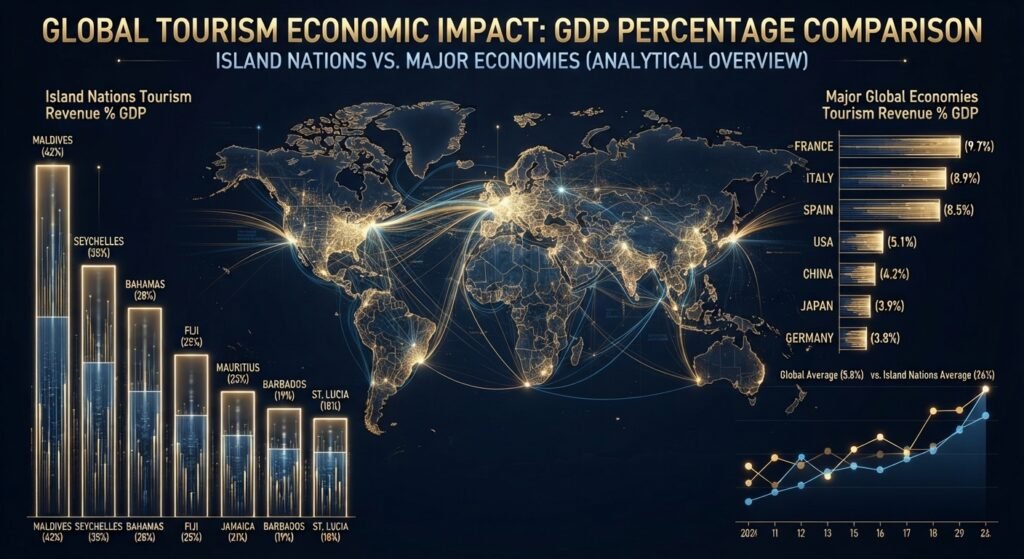
- Macroeconomic Disparity: While micro-states and island nations derive up to 70% of their GDP directly from tourism receipts, major superpowers rely on travel as a high-value service export.
- Employment Multiplier Effect: The sector accounts for hundreds of millions of jobs globally, acting as a primary driver for urban and regional labor markets.
- Vulnerability to External Shocks: Economies built heavily on travel revenue remain uniquely sensitive to geopolitical friction, currency fluctuations, and global transport costs.
Macroeconomic Mechanics of Travel-Driven Nations
To understand how countries sustain themselves within the global tourism economy, economists measure international tourism receipts as a direct percentage of gross domestic product. Unlike localized commerce, incoming tourist spending introduces foreign capital directly into domestic markets, functioning similarly to an export-driven cash influx.
Micro-states and island economies—such as Andorra, Aruba, and the Maldives—lead the world in dependency, drawing over two-thirds of their entire economic output from visitor spending. For these regions, robust airport infrastructure, hospitality networks, and streamlined visa frameworks are not mere conveniences; they are existential requirements for national solvency.
Comparative Overview of Tourism-Dependent Destinations
A review of contemporary international travel metrics illustrates how distinct geographic models capitalize on visitor revenue:
| Country / Region | Tourism Share of GDP | Primary Economic Driver | Key Vulnerability Factor |
| Andorra | ~71.8% | Alpine sports and duty-free retail | Seasonal weather and regional European travel trends |
| Maldives | ~68.0% | Luxury resort islands and marine tourism | Global economic downturns affecting high-end luxury spending |
| United Arab Emirates | >10.0% | Business hubs, aviation, and luxury tourism | Regional geopolitical stability and airline operational costs |
Channels Transforming Visitor Spending Into Sovereign Wealth
1. Capitalizing on International Service Exports
In the framework of the global tourism economy, spending by foreign visitors is classified as an export of services. When international travelers pay for hotels, dining, local transport, and entertainment, they inject fresh foreign currency into the host nation’s banking system, strengthening national reserves and supporting local currency stability.
2. Infrastructure Development and Real Estate Synergy
To capture high-yield travel revenue, governments invest heavily in modernizing public transit, expanding international airports, and developing smart urban centers. This structural upgrade concurrently benefits domestic citizens, triggering secondary commercial growth across retail, construction, and telecommunications.
Navigating Structural Headwinds and Over-Tourism Risks
Despite providing immense financial benefits, maintaining stability within the global tourism economy requires continuous navigation of complex systemic risks:
- Over-Tourism and Environmental Strain: Unchecked visitor density can degrade natural ecosystems, overload municipal waste systems, and price local residents out of housing markets.
- Geopolitical and Health Disruptions: Pandemics, regional conflicts, and shifting airline safety regulations can cause sudden, catastrophic drops in international arrivals.
- Labor Shortages and Wage Inflation: The hospitality and service sectors frequently struggle with retention, forcing businesses to adapt to rising operational overheads.

Conclusion
The expansion of the global tourism economy underscores the vital role that service sectors play in modern wealth creation. Nations that master the balance between infrastructure expansion, environmental sustainability, and diversified economic planning will continue to thrive, securing robust national revenues from the ever-growing wave of international travelers.
Frequently Asked Questions (FAQs)
What defines the global tourism economy?
It encompasses all economic activities, industries, and services directly or indirectly supporting travel—including accommodation, transportation, entertainment, and food services—generating trillions in global GDP.
Which countries are most dependent on tourism revenue?
Small island states and micro-economies like Andorra, Aruba, and the Maldives lead the world, generating more than two-thirds of their total GDP from international visitor spending.
How does tourism impact a nation’s balance of payments?
Incoming international tourism acts as a service export, bringing foreign currency into the host nation, which helps offset trade deficits and strengthen economic reserves.
Why do large economies rely less on tourism for GDP?
Large superpowers like the United States and China have highly diversified economies where manufacturing, technology, finance, and domestic consumption dominate overall economic output.
Global Tourism Trends and Economic Impact Insights
This analytical resource breaks down how international institutions track travel receipts, hospitality growth, and tourism-dependent market shifts.
1 thought on “Global Tourism Economy: Nation Travel Income”